Knowledge Base
Testing the Tensile Strength of Paper

Tensile testing paper can reveal a wealth of information essential for the manufacturer of everything from tissue paper to corrugated cardboard or paperboard. It can help you determine characteristics such as paper stiffness, modulus and tensile strength, as well as tear length and energy absorption.
Why is testing the tensile strength of paper important?
Knowing the tensile strength of paper is essential for a wide number of industries. Whether you need to ensure that instruction leaflets are sufficiently tear resistant to be included with products or you’re developing tissues that need to withstand a runny nose, tensile strength testing can help you find out when your paper might be susceptible to a web break.
It is also particularly important for the packaging industry, where tensile testing is critical for measuring the elongation of paper and board. It can also be key in determining the maximum load those materials can take before failure.
Determining paper tensile strength
To determine the tensile strength of paper, a sample is typically cut to a predetermined size and then placed in a testing machine which applies force until the paper tears. Tensile strength is also measured in two directions, the machine and the cross direction, because of the ways that the fibers bond when paper is made on a machine.
Testing the tensile strength of paper is similar to the tensile testing methods applied to other materials, but the way of expressing it is different. For most materials, tensile strength is referred to as the load per unit cross-sectional area. In paper industry, it’s more common for the tensile strength to be given as the load per unit of the sample.
It’s also expressed in relation to paper weighting and grammage. So, the tensile index is recorded as the tensile strength divided by basis weight, this is recorded as Nm/g. The lower the paper is on the tensile index, the lower the strength of the paper.
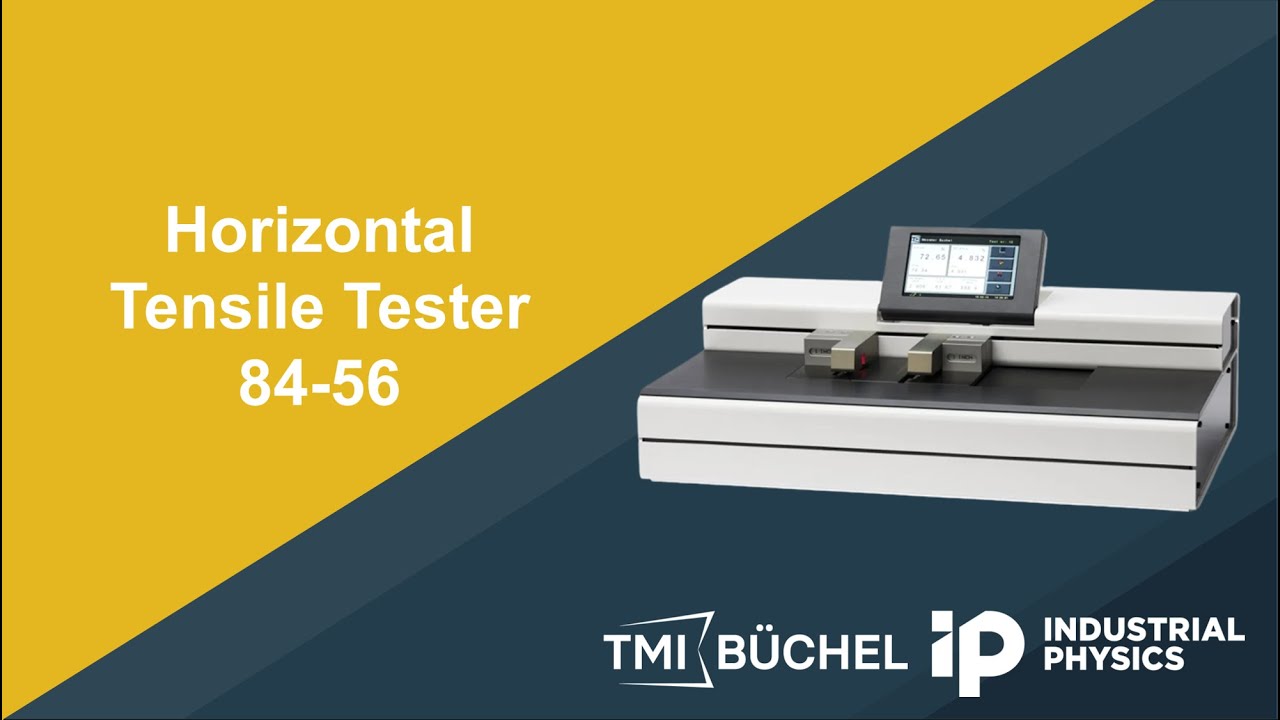
Discover the Power of TMI Büchel Horizontal Tensile Tester
International standards for tensile paper testing
When you want to ensure that your paper tensile testing is meeting internationally recognized standards, then following the ASTM D828 method is an excellent idea.
ASTM D828 is the standard method for determining the tensile properties of paper and paperboard by using constant-rate-of-elongation apparatus. It can be used to test tensile stiffness, breaking length, tensile energy absorption, and tensile index, as well as tensile strength and stretch.
Also worth noting is Tappi T494, which tests the maximum tensile force a test specimen can bear before rupture and is used for paper and board. Check out our recommended PROFILE/Plus® machines for testing to Tappi T494 standards.
Complete paper testing system
Whether you’re looking for a single testing solution to address a particular issue or you’re looking to refit an entire paper mill, Industrial Physics can help. our specialist brand Technidyne has developed an innovative building block system called PROFILE/Plus®, which lets you build an automated testing system one instrument at a time.
Find everything you need for testing the physical and optical properties of paper in our full PROFILE/Plus® range.
Was this useful?
Related Products
-

United Testing DFM Series Floor Model Universal Test Machine (UTM), 100-600 kN
The United Testing DFM Series is a floor-model universal testing machine available in 100, 150, 300 and 600 kN force capacities - built for tensile, compression, flex and advanced materials testing across aerospace, automotive, construction and R&D applications, with DragonFly UTS software included as standard.

-

United Testing UTM (Universal Testing Machine) - DSTM 5-25 kN Table Top
The United Testing DSTM Series is a table-top universal testing machine available in 5, 10, 20 and 25 kN capacities - built for plastics, films, rubber, textiles, adhesives and small-fastener testing with DragonFly UTS software included as standard.
-

TMI Büchel Horizontal Tensile Tester 84-56
This modern and robust Horizontal Tensile Tester is an ideal solution for measuring the properties of everything from tissue paper to packaging board. Obtain fast and reliable results from our tensile testing machine.

-

TMI Büchel Internal Bond Tester 80-26
A useful internal bond tester designed to determine the internal bond strength of paper and board materials in the Z direction. Assess the internal bond strength of paper and board specimens to a high level of accuracy.
-

Technidyne PROFILE/Plus® Burst
Automated Bursting Strength measurement in accordance with TAPPI T403 or T807 and ISO 2758 or ISO 2759. Fully-automated measurement of top or bottom side Burst. Includes paper feed for automated profile testing.

-

Ray-Ran Advanced Pendulum Impact System
The Ray-Ran Advanced Pendulum Impact System measures the energy required to break or rupture plastics, composites and ceramics for Izod, Charpy, Tension Impact, Pipe and Component testing. Compliant with international standards including ISO 180, ISO 179, ASTM D256 and ASTM D6110, with hammer energies from 0.5 J up to 50 J.

-

TMI Büchel Elmendorf Tear Tester
When you're looking for a reliable tearing tester, the TMI Büchel. Elmendorf Tear Tester is the perfect choice. Its easy-to-use software and innovative design makes it a revolutionary option for carrying out Elmendorf tear tests.
FAQs
-
Tensile strength testing measures the force required to pull a material until it breaks.
-
It is tested using a tensile testing machine that applies force until the paper tears.
Related Articles
-

Key terms Term Definition Double seam The mechanical interlock that joins a can end to the can body; the primary barrier against leaks. Non-destructive testing Inspection that measures a can without cutting or destroying it, allowing higher inspection frequency. Destructive teardown Traditional seam inspection that cuts the can apart to measure internal seam features by…
-

Beverage can manufacturing is a high-speed, high-volume business. A single line can turn coil into thousands of beverage cans a minute, through cupping, drawing and ironing, trimming, decorating, internal coating, necking, flanging and palletizing. Every one of those steps must stay within tight tolerances, because a small drift multiplied across a fast line becomes a…
-

A modern beverage can manufacturing line runs at extraordinary speed, producing thousands of cans a minute. That speed is where the profit is, but it is also where the risk is. Traditional quality checks, such as the manual dimensional measurements of trimmed or necked cans are time consuming and based on small samples. They force…
