Knowledge Base
Guide to Coefficient of Friction Testing

Everything you need to know about coefficient of friction testing
Coefficient of friction testing is a way to find out what happens when two items rub against each other. It can be used to determine the coefficient of friction (COF) value of everything from film covered corrugated products to household items like ceramic tiles.
It is also an essential part of the quality control process for any retail or e-commerce packaging manufacturers or users, as it shows how coated corrugated or paperboard will stand up to the rigours of shipping, handling and sales.
What is coefficient of friction testing?
COF testing is a method of determining the moving and starting resistance of one surface that is being dragged across another. The friction can be calculated for both kinetic and static states. It is also known as ASTM D1894 and is the standard testing method for determining the static and Kinect friction of films and plastic coatings.
Coefficient of friction testing methods
One of the most common COF testing methods to find out the static friction of a surface is to measure how much force it takes to move a sled placed on that surface. The amount of force needed is then divided by the weight of the sled, to give a calculation and rating.
For kinetic friction, a sled is also employed. The result is equal to the average force needed during uniform sliding of the surfaces divided by the sled weight. A low COF indicates smoother surfaces while a higher rating suggests that the surfaces are rougher and less slippery. In other words, a high COF will denote a low slip factor.
According to ASTM, it is equally effective to use a stationary sled with a moving plane or a moving sled with a stationary plane when calculating COF.
COF testing with Industrial Physics
When you choose COF testing solutions from us, you can be confident that they measure static and kinetic coefficient of friction with test methods compliant with ASTM standards.
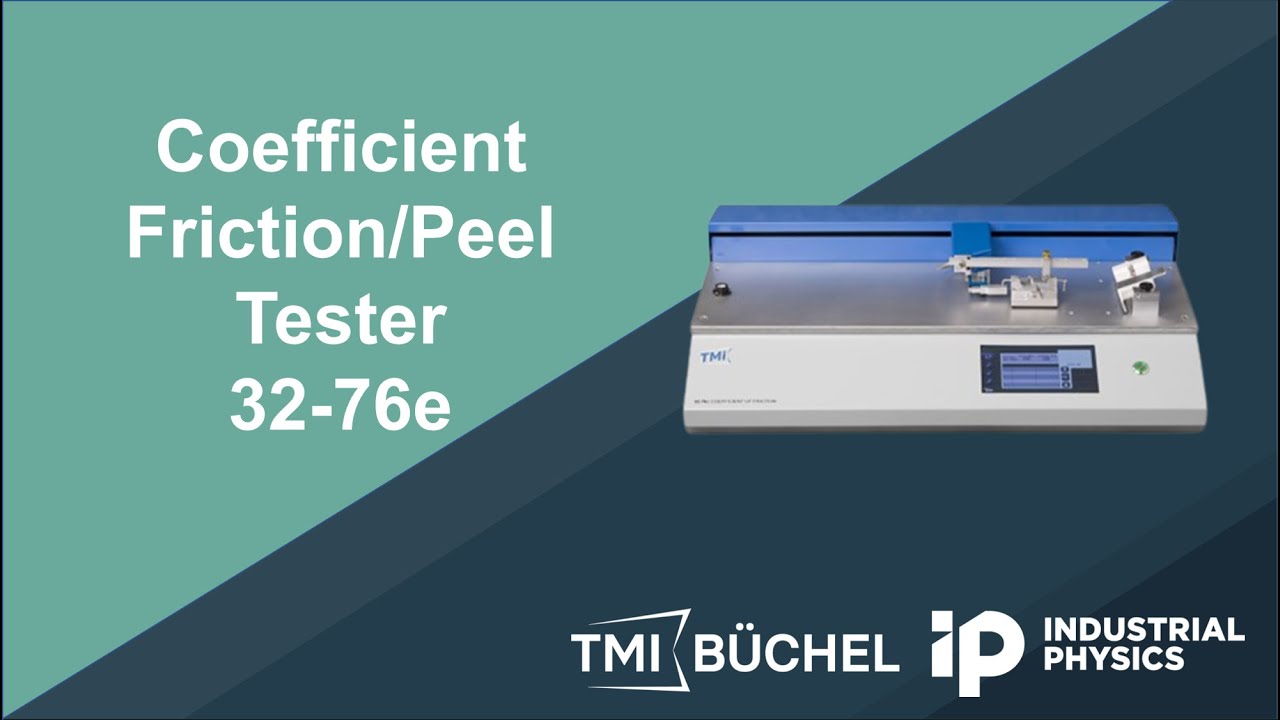
If you’re looking for a COF tester for use across a wide range of materials, the 32-76e Coefficient Friction/Peel Tester is an excellent choice. Suitable for a wide range of paper, corrugated, flexible films, rigid plastics and other engineered surfaces, this high-tech machine uses advanced digital force signaling and high-speed data acquisition software – making sure you get unmatched precision and repeatability in COF testing.
More help choosing your testing methods
With almost 100 years of corrugated paper testing experience, Industrial Physics is here to help. Whether you make or use flexible or rigid corrugated packaging, we offer reliable coefficient of friction testing equipment and can help talk through your needs and find the testing solution to suit you. Ready to find out more? Get in touch with our corrugated specialists.
Was this useful?
Related Products
-

TMI Büchel Coefficient Friction/Peel Tester 32-76e
Our 32-76e coefficient of friction tester offers unparalleled performance and flexibility to test across a wide range of standards for COF, peel testing, adhesion testing and heat seal applications.

-

TMI Büchel Slide Angle COF Tester 32-25
The Slide Angle Coefficient of Friction Tester 32-25 provides static coefficient of friction testing using the inclined plane method and conforms to a large number of stringent standards from ASTM, TAPPI and ISO.
FAQs
-
The coefficient of friction is a measure of the resistance to sliding between two surfaces.
-
It is tested using a tribometer, which measures the force required to slide one material over another.
-
As well as being an important part of the testing process to see if materials can be safely used during the manufacturing process or as part of a product’s packaging, it can also indicate how well coated corrugated or paperboard will stand up to the rigors of shipping, handling and sales. Find out more about how coefficient of friction testing works in our guide to coefficient of friction testing.
Related Articles
-

Key terms Term Definition Double seam The mechanical interlock that joins a can end to the can body; the primary barrier against leaks. Non-destructive testing Inspection that measures a can without cutting or destroying it, allowing higher inspection frequency. Destructive teardown Traditional seam inspection that cuts the can apart to measure internal seam features by…
-

Beverage can manufacturing is a high-speed, high-volume business. A single line can turn coil into thousands of beverage cans a minute, through cupping, drawing and ironing, trimming, decorating, internal coating, necking, flanging and palletizing. Every one of those steps must stay within tight tolerances, because a small drift multiplied across a fast line becomes a…
-

A modern beverage can manufacturing line runs at extraordinary speed, producing thousands of cans a minute. That speed is where the profit is, but it is also where the risk is. Traditional quality checks, such as the manual dimensional measurements of trimmed or necked cans are time consuming and based on small samples. They force…
