Knowledge Base
How Are Beverage Cans Made?

The average beverage can has to do a lot of heavy lifting. It is expected to be light, incredibly well-sealed, and designed to help the contents reach the optimal temperature quickly.
Today’s cans fulfill all these criteria and more, thanks to modern technology and materials – read on to find out how.
What are drinks cans made of?
Roughly three quarters of the world’s beverage cans are made from aluminum. Not only is it cheap and efficient, it’s also infinitely recyclable. The remaining quarter are made from tin-coated steel, which is also the most popular choice for food cans. So, what are food and beverage cans made from?
The aluminum used in beverage cans is alloyed with manganese and magnesium to improve strength and ductility (its ability to deform rather than fracture under pressure). Different alloys and aluminum thicknesses are used for different components of a can.
Aluminum measurements and alloys can be tweaked for maximum efficiency, but must always be carefully QA tested to ensure that they are of a sufficient strength and thickness to avoid warping or implosion. This is an integral part of any can inspection process.
How cans are made
There are two main methods for making beverage cans – the 2 piece can and the 3 piece can – and the manufacturing processes differs for each. 2 piece cans by far dominate the beverage industry, but 3 piece cans are still in use in some parts of the world, particularly for non-carbonated beverages.
How a 3 piece can is made
A 3 piece can has three main components: a body and two ends. For a body, a flat panel is mechanically formed into a cylinder and welded. The body may then be beaded or necked for ease of stacking or display. It is also often coated with a lacquer, depending on the materials used and eventual purpose. The ends are attached by a seaming process, typically a double seam.
How a 2 piece can is made
A 2 piece can is made of two main parts: the body and one end. The body is made from a disc, typically aluminium, and reformed into a cylinder with an integral end. Another end, or lid, is then attached with a double seam, closing the can.
Get the low down on the pros and cons of each can design in our two-piece vs three-piece can guide .
How cans are double seamed
In both types of can, ends are sealed using a double seam. This process, crucial to the integrity of the can, attaches the can end or lid to the body by mechanical process. Three layers of the lid and two of the body are interlocked to create a seam. Done properly, it creates a hermetic seal to keep the contents fresh. Find out more about the process in our handy double seam guide.
Beverage can testing and completion
A crucial stage in the production of beverage cans is the testing and QA. Even fractional discrepancies can compromise a can’s integrity, causing leakage, venting or degradation of the content. For some insight into the way the beverage packaging industry is currently behaving and adapting, check out our Thirst for Perfection report.
Get help testing your beverage can production process
Need help ensuring your canning process is up to scratch? We’re perfectly placed to provide the support you’re looking for.
We have 50 years of experience in the beverage and canning industry and more than 3,000 unique products to help you find the ideal testing solution for your packaging and products. From double seam testing to axial load and implosion testing for 3 piece cans, get in touch to speak with our team.
End-to-End Metal Packaging Testing

Was this useful?
Related Products
-

Torus Z401 Automatic Beverage Shell Inspection Gauge
The Torus Z401 Automatic Beverage Shell Inspection Gauge defines the standard for precise, automated dimensional inspection of beverage and beer can shells, ensuring accuracy and repeatability in critical measurements.

-

Torus Z304 Semi-Automatic Benchtop Bead, Height and Flange Gauge
A semi-automatic benchtop combination gauge that provides accurate, objective and repeatable measurements for bead, height and flange inspections of food cans.
-

Torus Z301 Automatic Universal (Trimmed and Finished) Beverage Can Inspection Gauge
The Z301 Universal Gauge from Torus incorporates trimmed and finished can measurement into the same system, for full component measurement.
-

Torus Z307 Automatic Beverage Can Destructive Gauge
The Torus Z307 Automatic Beverage Can Destructive Gauge determines the maximum axial load force that can be applied prior to beverage container failure, within a short cycle time.
-

Torus Z403 Automatic Beverage Shell Compound Weight and Placement Gauge
The Z403 Automatic Beverage Shell Compound Weight and Placement Gauge has been designed to reduce the significant labor time associated with manual Compound Weight and Placement checks, whilst also reducing the risk of human error in this manually labor intensive process.
-

Torus Z601 Automatic Beverage End EOE Progression
The Z601 Automatic Beverage End EOE Progression sets the standard for inspecting all standard and enhanced inspection features across all conversion types.
-

Torus Z605 Automatic Beverage End Buckle and Burst Gauge
The Z605 Automatic Beverage End Buckle and Burst Gauge is the world's first End Buckle and Burst Gauge with up to three size capability with no manual change parts.
-

CMC-KUHNKE AUTO-XTS
The AUTO-XTS is the ideal double seam inspection solution for beverage or metal packaging testing. It offers highly accurate seam thickness, countersink depth, seam height and body hook testing.

-

CMC-KUHNKE SEAMscan XTS III
If you work with aluminum or steel cans, the SEAMscan XTS III will increase the accuracy of your double seam inspection testing, reduce spoilage, and save you time and money.
FAQs
-
Beverage cans are typically made from aluminum or tin-plated steel.
-
The process includes forming the can body, applying coatings, printing labels, and sealing the can with a lid.
Related Articles
-
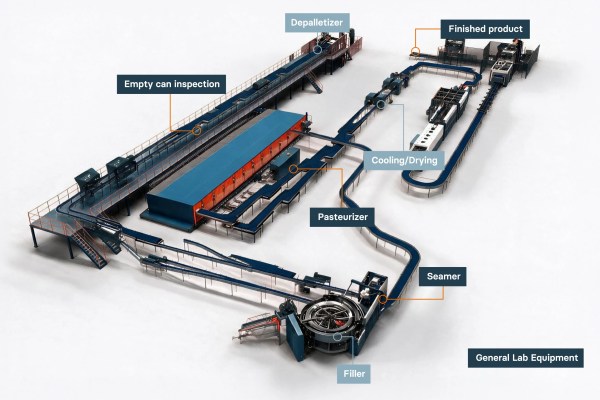
Explore every stage of the modern beverage can filling line with our interactive beverage can filling process map. From can depalletizing and rinsing through to filling, seaming, pasteurizing, and palletizing, each step in the process demands precision, consistency, and quality assurance. By hovering over each stage in the diagram below, you can discover the most…
-

Key terms Term Definition Double seam The mechanical interlock that joins a can end to the can body; the primary barrier against leaks. Non-destructive testing Inspection that measures a can without cutting or destroying it, allowing higher inspection frequency. Destructive teardown Traditional seam inspection that cuts the can apart to measure internal seam features by…
-

Beverage can manufacturing is a high-speed, high-volume business. A single line can turn coil into thousands of beverage cans a minute, through cupping, drawing and ironing, trimming, decorating, internal coating, necking, flanging and palletizing. Every one of those steps must stay within tight tolerances, because a small drift multiplied across a fast line becomes a…
