Knowledge Base
Exploring Melt Flow Testing Applications Across Materials: Choosing the Right Ray-Ran Indexer

Melt flow testing is one of the most widely adopted methods for assessing polymer quality and processing behavior. Whether you’re working with polyethylene, polypropylene, ABS, or engineering plastics, understanding how your material flows under heat and pressure is critical for quality control and product performance.
At Industrial Physics, we’ve designed our Ray-Ran Melt Flow Indexers to meet international standards like ASTM D1238 and ISO 1133, ensuring accurate, repeatable results. But which model is right for your lab? Let’s explore the fundamentals of melt flow testing and compare the three models in our range: MFR100, MFR200, and MFR300.
Why Melt Flow Testing Matters
Melt Flow Rate (MFR), often called Melt Flow Index (MFI), measures the mass of polymer extruded through a precisely controlled die under set conditions of temperature and load. Expressed in grams per 10 minutes, MFR provides insight into:
- Viscosity and molecular weight – Higher MFR generally indicates lower molecular weight.
- Processability – Helps determine suitability for injection molding, extrusion, or blow molding.
- Batch consistency – Essential for quality assurance and compliance.
Although MFR isn’t a fundamental property, it’s a practical benchmark for polymer performance and a key metric in resin specifications worldwide.
Applications Across Materials
Different polymers require different test conditions. For example:
- Polyethylene (PE): Typically tested at 190°C with a 2.16 kg load.
- Polypropylene (PP): Commonly tested at 230°C / 2.16 kg.
- ABS: Often tested at 200°C / 5.00 kg.
- High-performance polymers like PTFE or PPS demand higher temperatures (up to 315°C) and heavier loads (up to 21.6 kg).
Our Ray-Ran systems accommodate these variations with robust heating systems, precision dies, and a full range of test weights.
Comparing the Ray-Ran MFR Series
MFR100 – Manual Precision for Essential Testing
Ideal for: Labs performing basic MFR tests to ASTM and ISO standards.
Key Features:
- Digital temperature control (0–450°C, ±0.1°C accuracy).
- Manual operation with a large twin-color display and digital timer.
- Supplied with standard die, piston, and 2.16 kg test load.
- Best for: Quality control environments where simplicity and reliability matter.
- Optional extras: Weight loader for heavy loads, Hastelloy components for corrosive materials.
MFR200 – Advanced Control with Automation
Ideal for: Labs seeking improved efficiency and data handling.
Key Features:
- Intuitive touchscreen interface with integrated temperature control.
- Auto cut-off device for precise sample slicing.
- Calculates MFR and melt density at test temperature.
- Connectivity: USB, Ethernet, and direct download to USB flash drive.
- Compatible with Techni-Test software for data storage and reporting.
- Best for: Facilities needing automated sample cutting and digital record-keeping.
- Optional extras: Pneumatic weight loader for up to 21.6 kg loads.
MFR300 – Ultimate Flexibility and Multi-Method Testing
Ideal for: R&D labs and high-throughput environments.
Key Features:
- Performs Methods A, B, C, and D (including Flow Rate Ratio and Melt Volume Rate).
- Integrated encoder system for displacement-based testing.
- Calculates MFR, MVR, FRR, and melt density.
- Advanced touchscreen control with wireless connectivity.
- Full integration with Techni-Test software for batch statistics and graphical reporting.
- Best for: Users requiring comprehensive melt flow analysis and multi-standard compliance.
- Optional extras: Hastelloy upgrades, automated weight loader, and enhanced cutting systems.
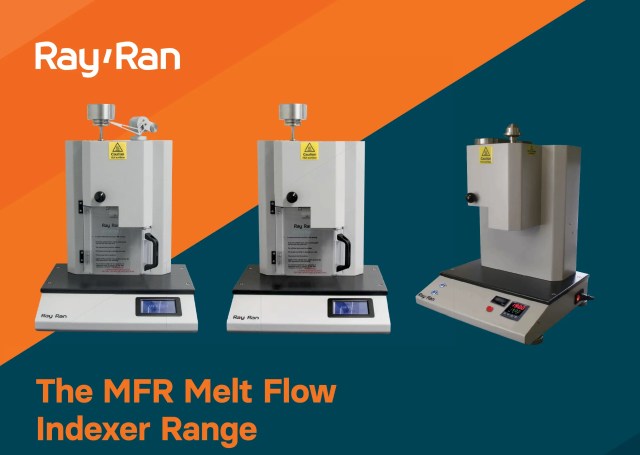
Quick Comparison Table
| Feature | MFR100 | MFR200 | MFR300 |
| Control Interface | Manual buttons | Touchscreen LCD | Advanced touchscreen LCD |
| Temperature Range | 0–450°C | 0–450°C | 0–450°C |
| Accuracy | ±0.1°C | ±0.1°C | ±0.1°C |
| Standards Supported | ASTM D1238, ISO 1133 | ASTM D1238, ISO 1133 | ASTM D1238, ISO 1133 (Methods A–D) |
| Auto Cut-Off | No | Yes | Yes |
| Density Calculation | Manual | Automatic | Automatic |
| Connectivity | None | USB, Ethernet, USB Flash | USB, Ethernet, Wireless |
| Weight Loader Option | Manual/Pneumatic | Pneumatic (Auto/Manual) | Pneumatic (Auto/Manual) |
| Advanced Testing | MFR only | MFR + Melt Density | MFR, MVR, FRR, Density |
| Best For | Basic QC | Automated QC + Data Management | R&D + Multi-Method Testing |
Which Model Should You Choose?
- Choose MFR100 if you need a cost-effective, manual solution for routine MFR testing.
- Choose MFR200 for automated cutting, density calculations, and digital data management.
- Choose MFR300 for complete flexibility, advanced test methods, and connectivity options.
Why Industrial Physics?
Every Ray-Ran Melt Flow Indexer is backed by:
- Traceable calibration certificates for compliance.
- Global service and support from Industrial Physics experts.
- Optional annual calibration services to maintain accuracy.
Ready to Improve Your Polymer Testing?
Explore the full range of Ray-Ran Melt Flow Indexers on our product page or contact our team for expert advice on selecting the right model for your application.
Was this useful?
Related Articles
-
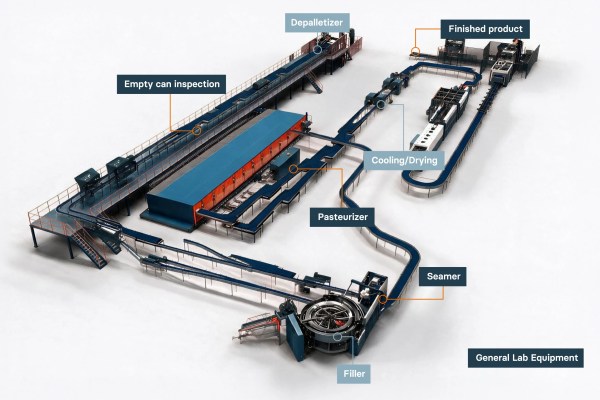
Explore every stage of the modern beverage can filling line with our interactive beverage can filling process map. From can depalletizing and rinsing through to filling, seaming, pasteurizing, and palletizing, each step in the process demands precision, consistency, and quality assurance. By hovering over each stage in the diagram below, you can discover the most…
-

Key terms Term Definition Double seam The mechanical interlock that joins a can end to the can body; the primary barrier against leaks. Non-destructive testing Inspection that measures a can without cutting or destroying it, allowing higher inspection frequency. Destructive teardown Traditional seam inspection that cuts the can apart to measure internal seam features by…
-

Beverage can manufacturing is a high-speed, high-volume business. A single line can turn coil into thousands of beverage cans a minute, through cupping, drawing and ironing, trimming, decorating, internal coating, necking, flanging and palletizing. Every one of those steps must stay within tight tolerances, because a small drift multiplied across a fast line becomes a…
