Knowledge Base
Featured Articles
-
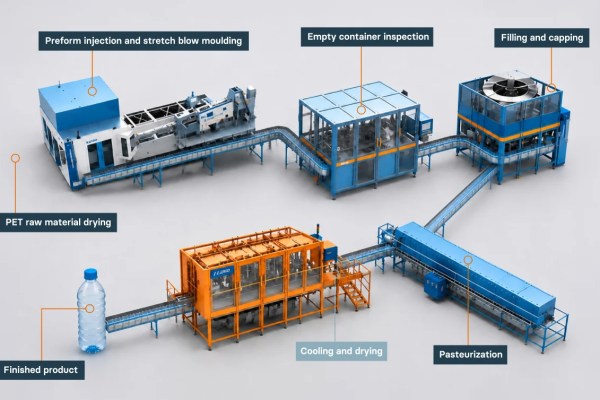
Explore every stage of the modern plastic bottle and container manufacturing process with our interactive process map. From raw material preparation and preform production through to stretch blow molding, filling preparation, inspection, labeling, and palletizing, every step requires precision, consistency, and rigorous quality control. By clicking on each stage within the diagram below, you…
-

Explore every stage of the modern canmaking line with our interactive beverage can manufacturing process map. From coil handling and cupping through to decorating, necking, and palletizing, each step in the process demands precision, consistency, and quality assurance. By hovering over each stage in the diagram below, you can discover the most relevant beverage can…
-

Overview Burst strength testing is one of the most widely used methods for evaluating the performance of sealed flexible packaging. It applies controlled internal pressure to a package until failure, measuring the point at which the seal or material gives way. For quality managers, R&D specialists, and operations experts working across flexible packaging production, burst…
-

Definition: Wet coating thickness measurement is the process of measuring the thickness of applied coating or paint layer immediately after it has been applied to a metal coil substrate — before the coated product enters the curing oven and dries. This is achieved using non-contact, optical sensor-based technology positioned inline at the point of application. Why it matters: In coil coating production lines, coatings travel at high…
-

Color consistency in metal can manufacturing refers to the ability to reproduce a brand's specified colors accurately and repeatedly across every decorated aluminum or steel beverage can - regardless of production run, facility, or geography. In the can-making industry, color is measured using three attributes: hue (the recognized color, such as red or blue), chroma (the vividness or saturation of that color), and lightness (how light or dark the color appears). These are quantified using…
-

Our metrology toolkit has been created by specialist experts with in-depth knowledge It offers insight and best practice advice for UK-based manufacturers working with CMMs, arms, height gauges, or master artefacts. Through UKAS-accredited Torus Metrology Services, you can rest assured that your metrology needs are being handled by true specialists with the appropriate knowledge, certifications, and expertise required to deliver results. Our free toolkit offers advice on…
-

To ensure that paints and coatings are easy to apply and durable in their nature, oils and additives are required. To know that the addition of these components doesn’t adversely affect the composition of your final paint or coating, you need thorough and efficient viscosity testing. Oils and lubricant additives in paint The addition of…
-

Can seaming to achieve robust, hermetically sealed metal packaging is a preferred practice to protect a wide range of types of products across many industries. An effective double seam is crucial to the integrity of a can. The process of can seaming has been around for decades and has undergone some massive transformations over the…
All Articles
Filters

Non-Destructive, Non-Parametric Pressure Measurement in Carbonated Beverages: An insight into NICO & NICOlab Both the handheld NICO and the benchtop NICOlab mark a significant innovation in the non-destructive measurement of CO2 levels in carbonated beverages. This technical exploration outlines the sophisticated mechanisms that underpin the NICO and NICOlab's cutting-edge capabilities, emphasizing its unique application of…

When it comes to liquids, specific gravity testing has a few big advantages. Wondering why it’s worth choosing specific gravity over density testing for liquids? Read on for our quick and simple guide. The differences between specific gravity and density testing With density testing, you are able to determine the weight of the liquid when…

What are the main types of viscometer? Get to grips with the main different types of viscometer out there and make sure you know which one might suit your test and measurement solution, with our handy guide. What is a viscometer? A viscometer is a device for measuring the viscosity of a sample. It is…

Viscosity testing is absolutely essential if you want to be confident that your paints, inks, varnishes and coatings stay in one place! Over time, deformation or flow can have a disastrous effect on the appearance of products or packaging. Measuring viscosity during the test and measurement process allows you to choose the right materials for…

Background Throughput of water vapour through packaging films or barriers has numerous drivers. The obvious one of typical food packaging is now well served by readily available permeation measuring instruments. The more demanding requirement for films used for the present commercial generation photo voltaic solar cells is arguably within the limit of present day commercial…

There are different ways to work with permeation rate calculations, depending on what you are testing for and the type of testing you need to carry out. If you want to find out how much oxygen will permeate through your package, or if you need to analyze the throughput of water vapor through packaging films…

Why is water vapor permeation testing important? And how do permeation testing instruments help you? Let’s start with the first question...in fact, there are several reasons, depending on what you make and how you make it. We can take a look at an obvious one - food packaging. Nobody wants a soggy, stale potato chip,…

Pressure Decay Leak Testing What is a pressure/vacuum decay test? Pressure decay testing measures the change in pressure between atmospheric pressure and your pressurized test sample. Unlike some other current methods of leak testing, this test method yields quantitative information, hard data points that can be recorded and upon which decisions can be made. This…
