Knowledge Base
Featured Articles
-
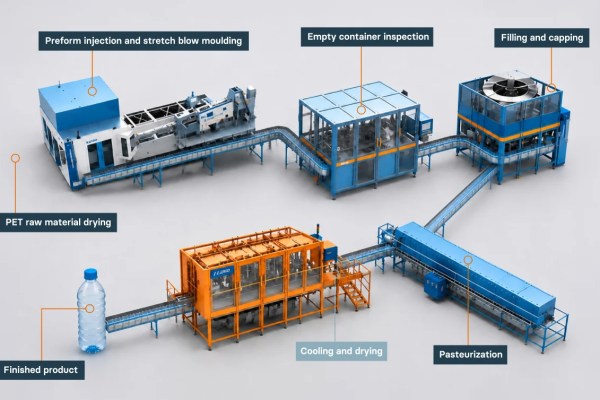
Explore every stage of the modern plastic bottle and container manufacturing process with our interactive process map. From raw material preparation and preform production through to stretch blow molding, filling preparation, inspection, labeling, and palletizing, every step requires precision, consistency, and rigorous quality control. By clicking on each stage within the diagram below, you…
-

Explore every stage of the modern canmaking line with our interactive beverage can manufacturing process map. From coil handling and cupping through to decorating, necking, and palletizing, each step in the process demands precision, consistency, and quality assurance. By hovering over each stage in the diagram below, you can discover the most relevant beverage can…
-

Overview Burst strength testing is one of the most widely used methods for evaluating the performance of sealed flexible packaging. It applies controlled internal pressure to a package until failure, measuring the point at which the seal or material gives way. For quality managers, R&D specialists, and operations experts working across flexible packaging production, burst…
-

Definition: Wet coating thickness measurement is the process of measuring the thickness of applied coating or paint layer immediately after it has been applied to a metal coil substrate — before the coated product enters the curing oven and dries. This is achieved using non-contact, optical sensor-based technology positioned inline at the point of application. Why it matters: In coil coating production lines, coatings travel at high…
-

Color consistency in metal can manufacturing refers to the ability to reproduce a brand's specified colors accurately and repeatedly across every decorated aluminum or steel beverage can - regardless of production run, facility, or geography. In the can-making industry, color is measured using three attributes: hue (the recognized color, such as red or blue), chroma (the vividness or saturation of that color), and lightness (how light or dark the color appears). These are quantified using…
-

Our metrology toolkit has been created by specialist experts with in-depth knowledge It offers insight and best practice advice for UK-based manufacturers working with CMMs, arms, height gauges, or master artefacts. Through UKAS-accredited Torus Metrology Services, you can rest assured that your metrology needs are being handled by true specialists with the appropriate knowledge, certifications, and expertise required to deliver results. Our free toolkit offers advice on…
-

To ensure that paints and coatings are easy to apply and durable in their nature, oils and additives are required. To know that the addition of these components doesn’t adversely affect the composition of your final paint or coating, you need thorough and efficient viscosity testing. Oils and lubricant additives in paint The addition of…
-

Can seaming to achieve robust, hermetically sealed metal packaging is a preferred practice to protect a wide range of types of products across many industries. An effective double seam is crucial to the integrity of a can. The process of can seaming has been around for decades and has undergone some massive transformations over the…
All Articles
Filters

Headspace testing is an important factor when it comes to testing the efficacy of vials for pharmaceutical use. Keeping medical products sterile and free of contaminants is an essential function of their packaging, and headspace gas analysis offers an accurate picture of a package’s performance in relation to the critical protection of the drugs supplied…

When you need to know the 02 concentration of a particular gas, oxygen analyzers offer the ideal solution. Fast, efficient and able to offer highly accurate results, these test and measurement solutions are frequently used throughout a number of sectors, from medical to beverages. Find out everything you need to know about oxygen analyzers in…

Headspace gas chromatography makes it possible to test even volatile substances for the presence of certain compounds, by utilizing and analyzing the associated vapor phase. It’s a technique that’s been around since the 1950s and one which is still useful today. What is gas chromatography? Gas chromatography is a method of separating and detecting the…

Considerations of the Effect of Atmospheric Pressure Changes on Potentiometric Zirconia Oxygen Sensor Measurements Introduction A potentiometric zirconia oxygen sensor is an electrochemical device that uses a high-temperature stabilized zirconium oxide electrolyte made from ceramics. The sensor consists of a tube which is closed off at one end with electrodes. These are typically platinum, deposited…

Systech use two major technologies in their trace O2 analyzers Most manufacturers and users of inerted reflow and wave soldering ovens use trace O2 analyzers to either measure the oxygen impurity or even with a feedback loop control the O2 impurity. There are many manufacturers of these instruments but only a small number that operate…

Paramagnetic Cells Technology For Our Paramagnetic O2 Analyser Oxygen is a paramagnetic gas and is attracted into a strong magnetic field. Because this measurement is a purely physical effect, nothing is consumed and in principle the cell has an unlimited life. However, contamination of the cell by dust, dirt, corrosives or solvents can lead to…

Gas used for medical purposes needs to be tested to the highest standards. Regular analysis of medical gas is required to ensure that the oxygen concentration is NLT 99.0% volume. Medical gas analysis using a paramagnetic signal USP37 Medical Gas requires a specific, selective and positive identification test using a paramagnetic signal. Following the appropriate…

Our carbon dioxide analyzers use infrared technology to measure percentage levels of the gas in most industrial processes. Infrared carbon dioxide sensors Designed by Systech, our global manufacturer of moisture, gas and oxygen analyzers, this innovative testing instrument uses an infrared sensor to capture accurate CO2 measurements. Our infrared carbon dioxide sensors…

Gases all have their own thermal conductivity. This conductivity can be measured and used as a way to help you understand how well heat moves through it, which can then be used to determine a gas type. Solutions for measuring the thermal conductivity of gases are most commonly used by industrial gas companies, metal heat…
